

 Ministry of Foreign Affairs and Expatriates Official Web Site
Riyadh
Minister of Foreign Affairs and Expatriates Dr. Afrah Al-Zouba affirmed that Yemen possesses the strategic location, resources, and potential needed to become an active partner in regional security and stability and in international trade. She stressed the importance of repositioning Yemen internationally as a promising opportunity and an added value, rather than as a crisis.
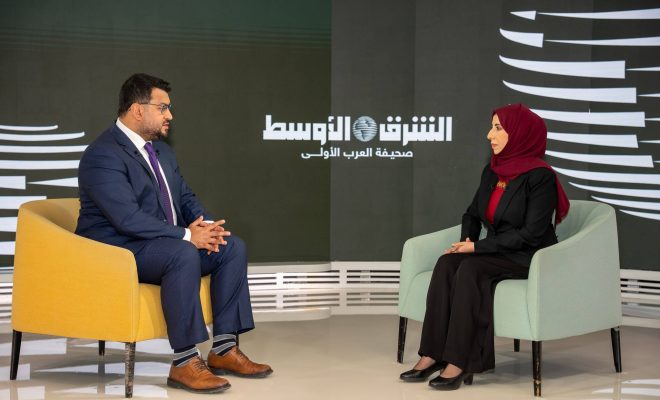
In an interview with Asharq Al-Awsat published on Wednesday, Minister Al-Zouba said Yemeni diplomacy should not go to the world merely to explain what Yemen needs, but also what Yemen can offer as a partner. She noted that the ambition is to move relations with friendly countries from crisis management toward building partnerships in maritime security, trade, energy, investment, recovery, reconstruction and capacity-building.
She affirmed that both the Government and the Yemeni people aspire to bring an end to years of suffering, and that any genuine political settlement must begin with ending the coup, restoring state institutions, and reaffirming the state’s sovereign right to hold the monopoly over arms and national decision-making.
The Minister placed Saudi Arabia and the Gulf Cooperation Council countries at the forefront of the partnerships Yemen seeks to strengthen, given geography, shared interests, and common security, alongside balanced relations with other friendly countries.
Addressing the relationship between the terrorist Houthi militia and Iran, Minister Al-Zouba said the Houthis pursue an ideological and racially discriminatory dynastic project at home that cannot be separated from their deep relationship with Iran. She described the relationship as one of “mutual instrumentalization,” whereby the Houthis benefit from Iran to strengthen their domestic project, while Tehran benefits from the Houthis and Yemen’s strategic location as instruments of influence and pressure in the region.
She noted that this relationship has expanded to include cooperation and exchanges of interests with terrorist elements and organizations, smuggling networks operating in Yemen, terrorist groups in the Horn of Africa, and armed groups in Iraq. This, she said, reflects a growing convergence of interests, tools, and smuggling routes and increases the scale of the transnational threat.
In her assessment of the latest Houthi escalation, the Minister stressed that there are no domestic reasons or developments that explain it. She pointed instead to a wider regional context linked to Iranian escalation and Tehran’s repeated attempts to use the Red Sea and maritime routes as arenas of pressure and disruption against international trade and the global economy.
She said attacks against state forces, civilians, displaced persons, and civilian and economic infrastructure, together with cross-border attacks and threats to shipping and international navigation, cannot be viewed as isolated incidents. Rather, they form part of a single escalation that is expanding geographically and applying pressure across multiple fronts. She noted that this is taking place while political efforts remain active, foremost among them the efforts of Saudi Arabia to return to a political track.
Al-Zouba reviewed the Government’s experience with the National Dialogue, the Kuwait negotiations, the Stockholm Agreement, and subsequent de-escalation initiatives. She explained that experience had revealed a recurring pattern in the militia’s behaviour: whenever it came under pressure, it moved toward de-escalation, only to rebuild its strength, reinforce its capabilities, and return to attack.
She stressed that a policy of containment, when not accompanied by clear consequences and costs for violations of commitments, may be understood as giving room for further violations. She reaffirmed the state’s sovereign and legitimate right to defend its citizens, armed forces, and institutions, and to take necessary and proportionate measures to deter attacks, with the ultimate aim of reaching a genuine political settlement that ends the coup and restores state institutions.
On the Red Sea, the Foreign Minister said Yemen’s geographic position gives it a major responsibility in the Red Sea, Bab al-Mandab, and the Gulf of Aden, given that these waterways are vital arteries for trade, energy, and global supply chains.
She described the multinational defensive maritime coalition launched by Saudi Arabia as an important step that shifts maritime protection from fragmented responses toward institutional cooperation encompassing the protection of vessels, information-sharing, maritime domain awareness, training, and capacity-building. She stressed, however, that protecting ships at sea alone cannot provide a sustainable solution unless the Yemeni state is able to extend its authority over its coasts, ports, and territorial waters and strengthen the capabilities of the Coast Guard, naval forces, port security, and anti-smuggling operations.
She stressed that the value of international positions is demonstrated when they are translated into practical measures, including the effective implementation of UN Security Council resolutions, sanctions regimes, and the arms embargo; shutting down routes used to smuggle missiles, drones, dual-use components, and technical expertise; holding accountable the networks that finance or facilitate such activities; and strengthening the capabilities of Yemeni state institutions.
On the humanitarian situation, Minister Al-Zouba stressed that Yemenis are not bargaining chips and must not be turned into instruments of pressure or hostages to political and military calculations. She emphasized that a sustainable response to the crisis requires supporting state institutions and enabling them to carry out their responsibilities in education, health, public services, and the protection of citizens.
Regarding the priorities of the Ministry of Foreign Affairs, the Minister said efforts would focus on enabling Yemeni diplomacy to keep pace with the state’s political agenda and defend its interests, improving services for Yemenis abroad, strengthening the Ministry’s institutional structure, and completing ongoing reforms so that it operates as one unified institution with a professional cadre and a coherent message.
In her message to Yemenis at home and abroad, Al-Zouba stressed that “Yemen is greater than these difficult years.” She said the priority at home is to restore the very idea of the state: a state that protects its citizens, holds the monopoly over arms and sovereign decision-making, and is founded on the rule of law and equal citizenship. Internationally, she said the goal is to restore Yemen’s natural place as a sovereign state with an ancient civilization and to ensure its diplomacy reflects the image of a people capable of building, engaging with others, and contributing to the stability of their region.
The Foreign Minister concluded by stressing that Yemen should no longer remain captive to the image and consequences of crisis, adding: “The stronger and more stable the Yemeni state becomes, the more Yemen becomes an added value to regional security rather than a burden on it.”