

 Ministry of Foreign Affairs and Expatriates Official Web Site
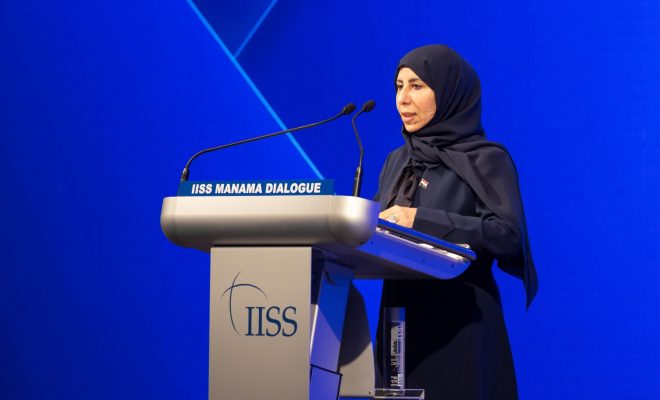
Statement by H.E. Dr. Afrah Abdulaziz Al‑Zouba, Minister of Foreign and Affairs and Expatriates of the Republic of Yemen, Third Plenary Session of the Manama Dialogue 2026 , Foundations of Regional Security, Saturday, 31 October 2026
Your Excellencies, Distinguished Guests, Ladies and Gentlemen,
Allow me at the outset to extend my sincere thanks to the sisterly Kingdom of Bahrain and to the International Institute for Strategic Studies for organizing this dialogue and providing this important platform for exchanging views on shared challenges and ways to enhance regional security.
The Yemeni experience confirms the interconnectedness of the security of the region’s states. The consequences of the coup against the state have extended beyond Yemen’s borders to affect the security of neighboring countries, maritime navigation, and international interests. Accordingly, supporting the restoration of Yemeni state institutions and strengthening their capabilities is a shared responsibility that requires translating solidarity into action that addresses sources of threat and lays the foundations for lasting stability.
From this perspective, building sustainable regional security rests on four foundations:
First: Respect for the sovereignty of states and strengthening the effectiveness of their national institutions
There can be no stability in the presence of interventions that undermine national decision-making or support armed groups that challenge the authority of the state. The Yemeni case illustrates the seriousness of this challenge, as external support for the Houthi terrorist militia has contributed to prolonging the war and expanding its threats to neighboring countries and international navigation. The 2024 report of the UN Panel of Experts indicated that the militia received weapons, technical assistance, training, and financial support from Iran, Iraqi armed groups, and Hezbollah. A state capable of exercising its authority and protecting its citizens remains the cornerstone of any regional security architecture.
Second: Prioritizing diplomacy and dialogue in managing regional disputes
Differences in interests are natural, but turning them into open conflicts increases the cost of instability. This underscores the importance of preventive diplomacy and inclusive regional mechanisms based on non-interference and good-neighborly relations. Any process concerning Yemen must be led by the Yemeni state, safeguard its sovereignty and the agreed references for a solution, and lead to the restoration of its institutions and the exclusive control of weapons by the state. Creating the conditions for such a process requires an end to attacks and the enforcement of the arms embargo.
Third: Adopting a comprehensive concept of security
Security should extend beyond the military dimension to encompass economic stability, energy security, food security, the protection of civilians and vital infrastructure, and the fight against terrorism and smuggling. Investment in development, institution-building, and the continuity of basic services are essential prerequisites for sustainable security.
Fourth: Protecting maritime corridors and international trade routes
Our region is home to the Strait of Hormuz, the Bab al‑Mandab Strait, the Red Sea, and the Gulf of Aden. Any threat to navigation in these waterways has direct implications for global trade and supply chains. Houthi attacks on vessels, and the resulting human and material losses, have demonstrated that protecting maritime corridors requires addressing the sources of threat by stopping the flow of weapons, financing, and expertise, combating smuggling networks, and strengthening the capabilities of coastal states while respecting their sovereignty.
In this context, the links between armed groups and organized crime networks present a growing danger. The 2025 Panel of Experts report documented increasing cooperation between the Houthis and Somalia’s Al‑Shabaab movement in arms smuggling, training, and the exchange of military expertise. This requires enhanced information-sharing, disruption of financing sources, and monitoring of cross-border transfers of weapons and expertise.
Ladies and Gentlemen,
Security in the Red Sea and the Bab al‑Mandab Strait cannot be separated from stability in Yemen. Security along the coast begins with security on land, and the protection of civilians and cities is a pillar of regional security. The siege imposed on Taiz by the Houthi terrorist militia constitutes a war crime, in which the population’s access to food, medicine, and fuel is used as a means of pressure and political blackmail. This situation requires the urgent lifting of the siege and the permanent and safe reopening of roads.
We call upon the United Nations to support an urgent investigation into field reports concerning the alleged use of projectiles suspected of containing toxic substances. In Aden, repeated attacks on the airport continue to threaten civil aviation safety and the delivery of humanitarian assistance.
Addressing the sources of threat requires ending the coup, restoring state institutions, and extending state authority while preserving Yemen’s unity, sovereignty, and territorial integrity, in accordance with the three agreed references: the GCC Initiative and its Implementation Mechanism, the outcomes of the National Dialogue Conference, and relevant Security Council resolutions, particularly Resolution 2216. This also requires stopping the flow of weapons and financing to the militia, ensuring that weapons and decisions of war and peace remain exclusively in the hands of the state, and preventing the exploitation of Yemen’s strategic location, territory, coastline, and islands to threaten neighboring states and international navigation or serve external agendas.
The Yemeni Government continues its efforts to restore the state and does not ask anyone to fight on its behalf. Rather, it seeks support from its partners for this effort, the strengthening of its institutions, and the enforcement of the arms embargo and the cessation of arms flows to the militia in accordance with Security Council Resolution 2216, thereby protecting the security of Yemen and the region.
Your Excellencies,
The true test of regional security lies in translating positions into practical steps that address the sources of threat. We are convinced that a stable Yemen, with institutions capable of securing its territory and coastline, will regain its constructive role within its Arab and regional environment and once again become, as it has historically been, a strategic depth for its brothers and a partner in safeguarding regional security, protecting international navigation and trade, and building a future in which the peoples of the region enjoy security, dignity, and development.
In conclusion, while Yemenis defend their state, they are also defending the security of this region, its waterways, and global commerce. There can be no sustainable regional security without a secure and stable Yemen, and this objective cannot be achieved so long as the Houthi terrorist militia continues to pose a threat, sparing neither Yemenis, nor their neighbors, nor international navigation.
Thank you.