

 Ministry of Foreign Affairs and Expatriates Official Web Site
Washington D.C
Yemen’s Ambassador to the United States of America, Jamila Ali Raja, affirmed that recent Houthi attacks are neither random acts of piracy nor a reaction to immediate developments, but rather come in the context of a broader Iranian scheme aimed at expanding regional influence and bolstering negotiating leverage, stressing that the Houthi militia does not represent the Yemeni state and prioritizes Tehran’s agenda over the interests of the Yemeni people.
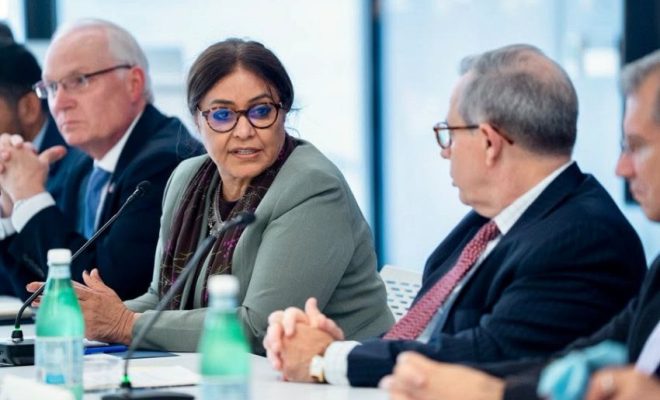
This came during her participation in a roundtable organized by the Middle East Institute in the U.S. capital, Washington, attended by a number of decision-makers, opinion-makers, researchers, and diplomats, dedicated to discussing the latest escalations in the region and their implications for Yemen and regional security.
Ambassador Raja explained that it is in the nature of armed militias to engage in reckless ventures without regard for human and material losses, and to bypass legitimate state institutions in negotiation and dialogue, pointing out that the Houthis do not deal with Yemen as an independent state whose national interests take precedence over all else, but rather work to transform it into a launchpad to serve Iran’s regional agenda, including threatening the security of international navigation.
She indicated that the Houthi militias continue to exploit allegations of what they call the “blockade” to cover up their connection to the Iranian agenda, whereas facts confirm that they were the party that obstructed peace tracks from the National Dialogue Conference in 2013 up to the UN truce in 2022. They also caused the choking of the national economy by preventing oil exports—the primary source of public revenues—and hijacked the present and future of Yemenis through imposing their ideological project, altering educational curricula, violating human rights, and harnessing public resources to serve their war effort.
Ambassador Raja also reviewed the repercussions of Houthi violations on the humanitarian and economic situations, explaining that the militias have detained more than 70 UN personnel, humanitarian workers, and foreign mission employees, with some facing death sentences, which undermines humanitarian operations at a time when millions of Yemenis rely on international aid.
She said, “The Houthi attacks on oil export facilities deprived the government of exporting crude oil, causing losses estimated at approximately six billion dollars during the period from 2022 to 2026, which affected the revenues allocated for paying salaries, providing electricity, and basic services,” noting that the government, in cooperation with the Kingdom of Saudi Arabia, continued to secure financial support and oil derivatives to ensure the continued delivery of basic services and alleviate the suffering of citizens.
Ambassador Jamila Raja added, “The government also welcomed efforts aimed at facilitating flights between Sana’a and Amman, despite the Houthi militias hijacking four civilian aircraft and causing their destruction,” considering that the militias’ rejection of humanitarian initiatives reveals the clear contradiction between their practices and their claims regarding alleviating civilian suffering.
Ambassador Raja reaffirmed that the Yemeni government, despite growing challenges, is proceeding with the implementation of the reform program and working to establish an effective model of governance and improve the performance of state institutions, while adhering to the option of peace, protecting Yemen’s sovereignty, fulfilling its international responsibilities, restoring state institutions, and ending the Houthi coup.
She emphasized that the interests, security, dignity, and aspirations of the Yemeni people must remain above all considerations, stressing the necessity of not allowing Yemen to be turned into an arena of conflict to serve regional agendas.